
React & Magento 2: a look into building Apple Premium Reseller iDeal’s new e-commerce platform
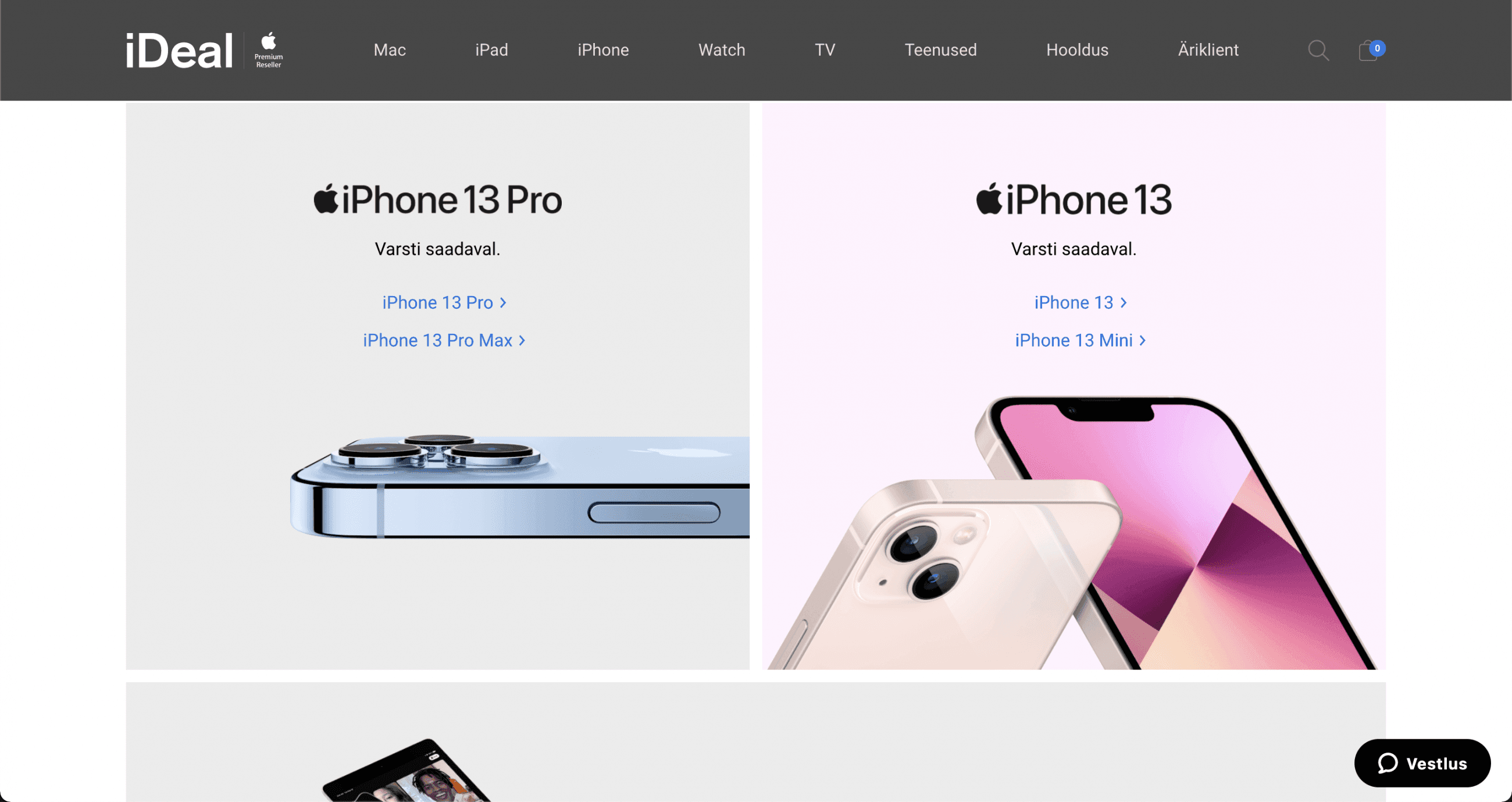
Apple is synonymous with quality, and so are their Premium Resellers. As such, when one of the biggest Apple Premium Resellers in the Baltics and Nordics, iDeal, approached Opus with the task to rebuild their dated web presence, it was clear that innovative approaches, the utmost focus on quality, and impeccable design were the words of the day.


Apple is synonymous with quality, and so are their Premium Resellers. As such, when one of the biggest Apple Premium Resellers in the Baltics and Nordics, iDeal, approached Opus with the task to rebuild their dated web presence, it was clear that innovative approaches, the utmost focus on quality, and impeccable design were the words of the day.
iDeal approached Opus with a seemingly simple task: the old Magento 1-based online store had reached the end of its serviceable life, the design of the store needed an overhaul to meet Apple’s guidelines, and as with any store in the modern era, maintaining outstanding SEO was paramount.
While the original idea was to simply migrate the old Magento 1-based store over to Magento 2, use it for both the backend and frontend, and update the design along the way, it became apparent that this was neither the most effective nor the most optimal thing to do. Instead, Opus’s team decided on a novel approach where the backend would remain with Magento, but the frontend duties would be handled by React.
The reasons for this approach were plentiful: alongside improved UX, speed, SEO options, and overall performance, it opened the option to later adopt the principles of headless e-commerce, where a single backend system can be easily tied to several different frontends.
The use of React also enabled advanced prototyping: all of the components could be created with React, reviewed and verified by the client, and then moved to the build pipeline. This gave the client a clearer overview of what they’d actually be getting and, by avoiding miscommunication and costly unnecessary iterations, cut time-to-market and development costs.
“Whilst React is powerful, it has its limitations, especially given that we started to build this Magento-React combination at a time where nearly nobody had attempted it,” said Tanel Särgava, the project manager responsible for iDeal’s new web store. “There were some growing pains along the way, especially related to maintaining search-engine positions post-migration, but our team managed to find the solutions.”
As with any large-scale online store, indexing, ever-growing product lists, and the vast amounts of data generated were also something to contend with. As such, Opus’s team took several approaches with different pages: there are pages where React’s only duty is to handle styles, and there are pages where React is used to its full potential.
“At every step of the way, we kept in mind the underlying needs for the store – speed, SEO, design, and the ease of management,” said Särgava, and noted that thanks to Magento 2, iDeal’s admin staff has seen a drastic drop in the amount of work that needs to be completed manually.
“We set up new automations, new integrations, and Magento 2 itself is also leaps and bounds ahead of its predecessor when it comes to managing listings and everything related to them,” said Särgava. “A good example is the new iPhones – with the old store it would have taken about a week to set everything up for the new release, with the new store the amount of time that has to be spent is reduced tenfold.”
All of this is achieved thanks to a cutting-edge tech stack and years of industry experience. “The database is based on MySQL, indexing is handled by Elastic, the front-end runs on React and the back-end is based on Magento 2 and PHP 7.4,” noted Särgava.
Thanks to React and Magento 2, iDeal is now able to offer its customers a more efficient, better-looking, and more reliable shopping experience, and to update its store’s functionality and design noticeably faster and more cost-effectively than before.
“It’s also worth noting that React, especially in case of projects where the use of it is a bit unconventional, is something that makes attracting new developers along the way a whole lot easier – expertise in Magento’s front-end is not that common, but the option to use React in a way it really hasn’t been used before is obviously attractive to experienced developers,” added Särgava.
iDeal’s comment on Opus’s work:
Extremely professional, proactive, and helpful team. They always manage to find the optimal solutions for all of the problems and development needs, and the quality of the work leaves nothing to wish for.
Want to join our team? Take a look at our open positions. We’re looking forward to hearing from you!
Can we help you as well? Get in touch with us! We’d love to talk.
Related services
E-commerce development to support rapid growth
E-commerce development on Magento, Adobe Commerce, MedusaJS and WooCommerce: analysis, UX, integrations and support. Partner to Apotheka, iDeal and AndBeauty.
Magento development tailored to your business needs
Magento development agency in Estonia: retail and B2B stores, integrations, payments, multi-country setups. We built Apotheka, iDeal and Rahva Raamat.
React development
React development: fast web apps, self-service portals, SaaS products and online stores. iDeal, Apotheka and Automaailm run on our React frontends.
Get in touch
We have your back when it comes to web development, giving you the freedom to focus on building and growing your company.

More posts
 A new logic for e-commerce advertising: the buyer’s question matters more than the keywordWhen someone searches for “a bed,” a retailer can show them an ad for beds. But when they ask AI which bed would suit two tall, light sleepers, the ad needs to address a much more specific need. According to Margus Eha, CEO of Opus, this is changing three things in e-commerce marketing at once: keywords are becoming less important, product data is becoming more important, and the final form of an ad is increasingly shaped by the buyer’s query.Read more
 Expert explains: today’s e-commerce success is no longer defined by bells and whistlesThe choice of platform on which to build an online store affects a company for years. According to Margus Eha, CEO of Opus, what matters today is no longer how much ready-made functionality a platform offers, but how quickly it can adapt to changing business needs.Read more
 Margus Eha: AI can put your online store on the list – but that alone is already yesterday’s newsIn recent years, online retailers have focused on making sure their products can be found in ChatGPT and other AI services. But according to Margus Eha, CEO of Opus, a developer of large-scale e-commerce platforms, the next phase has already begun: online stores must increasingly think about how to provide AI with information on exactly which products are in stock, when a specific item could reach a particular customer, and, if necessary, even which shelf it is located on in a physical store.Read more